
Origins
Origins Godere Forest, Ethiopia
The southwestern forest belt of Ethiopia is widely recognized as the primary center of genetic diversity for Arabica coffee. Our family's farm sits within this landscape not as a footnote, but as an active part of it.
Heritage
The Origin of All Coffee
Ethiopia is the birthplace of Arabica coffee. The southwestern forest belt of Ethiopia is widely recognized as the primary center of genetic diversity for the Arabica species home to over 10,000 documented Arabica accessions, representing a breadth of genetic variation found in no comparable region on earth.
Our family's farm sits within this landscape not as a footnote to that story, but as an active part of it.
The Origin of All Coffee
Heritage
Where Godere Coffee Grows
The Godere Forest is located in the Majang Zone, Gambella Region of western Ethiopia a high altitude tropical forest environment defined by dense canopy cover, exceptional rainfall, and some of the most fertile soil found in any coffee growing region in the world.
Godere Forest Ethiopian coffee grows in a landscape that remains less commercially established internationally than better known Ethiopian origins. This is a humid, biodiverse forest zone where coffee grows under natural shade canopy and rainfall exceeds 2,000mm annually.
The altitude and soil conditions here combine to produce Arabica with a distinct character emerging in specialty export markets as one of Ethiopia's most compelling and genuinely traceable single estate origins.
The terroir is intact. The varieties are diverse. The origin is genuine.
Terroir
Growing Conditions
The farm sits within an agro ecological zone recognized for ideal high quality Arabica production where altitude, climate, soil, topography, and natural vegetation exist in a combination particularly suited to specialty coffee cultivation.
Altitude
1,700 – 2,100 m above sea level
Rainfall
2,000 – 2,200 mm mean annual
Temperature
25–28°C day / 15–20°C night
Soil
Dystric Nitosol deep, red, well-drained, fertile
Shade
Natural forest shade canopy
Farm size
3,000 ha total / 700 ha mature coffee
The Coffee
Hand-picked, processed at origin
The farm produces 100% Arabica coffee grown within the natural forest environment of the Godere region.
Coffee is selectively hand picked only ripe red cherries are harvested ensuring that only fully developed fruit enters processing. Harvest runs from the end of November through the following months, aligned with Ethiopia's single annual harvest cycle.
Both natural and washed processing are carried out at origin on the farm. According to farm specifications, processing infrastructure includes a wet processing station and an artificial drier with a capacity of 8 tons per hour, alongside a dry processing unit with a capacity of 6 tons per hour.
This level of on-farm processing capability is uncommon in Ethiopian coffee production and is central to the traceability and consistency Olbino offers buyers.
After on-farm processing, coffee is transported to the family's facility in Addis Ababa for warehousing, sorting, packaging, and export preparation completing a supply chain that remains entirely within the family operation from cherry to shipment.
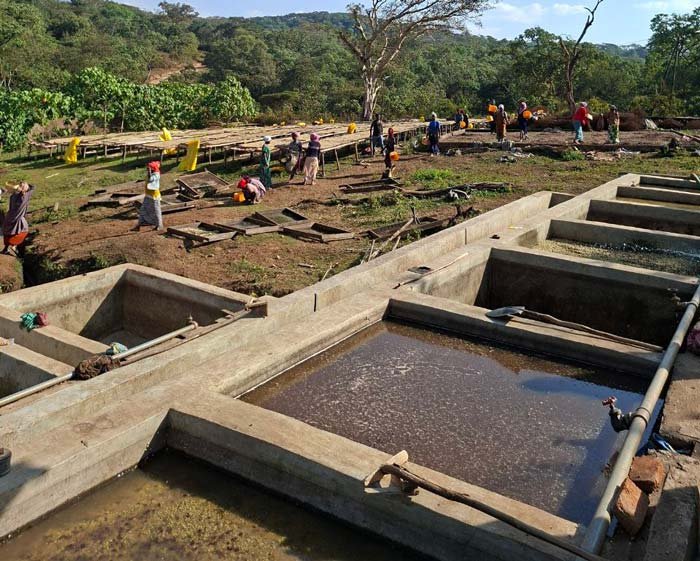
Washed Processing
Washed coffees are pulped and dry fermented for 24 to 72 hours to remove mucilage, then washed and dried on raised African beds at origin.
This method allows the intrinsic character of the Godere terroir to express itself clearly in the cup producing coffee with clean structure, defined acidity, and a distinct flavour profile shaped by high altitude Dystric Nitosol soils and natural forest growing conditions.
Current washed cup profile: Cocoa and nutty base with floral aromatics. Notes of dried fruit with mild acidity, medium body, and a clean, balanced finish.
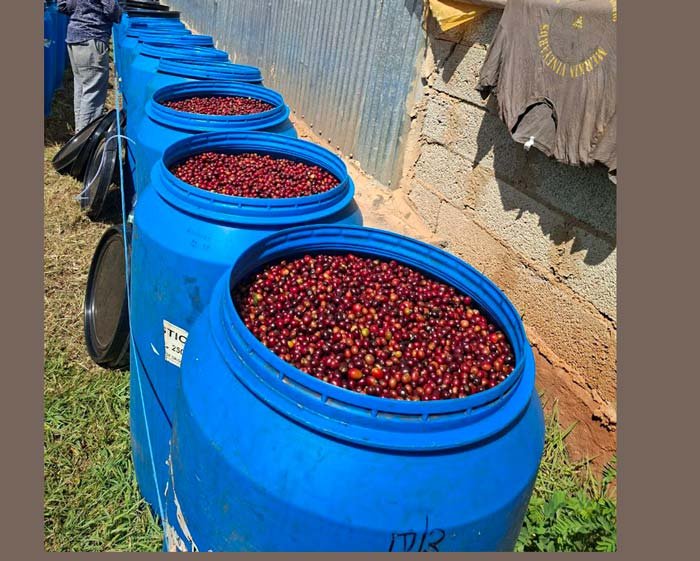
Natural Processing
Natural processed coffees are dried whole cherry intact on raised African beds, allowing the fruit to impart its character directly into the bean over an extended drying period.
This method produces coffee with greater body, fruit forward complexity, and a depth of flavour distinct from the washed lots.
Specialty grade natural lots are currently in development, with release planned for upcoming harvests. Buyers interested in being among the first to access specialty Godere naturals are encouraged to reach out directly.
What Sets It Apart
What Makes Godere Different
Most Ethiopian coffee reaches the market through cooperatives, washing stations, and intermediary exporters aggregated from multiple smallholder farms across a region, then sold under a broad origin designation. Traceability in that model is limited by design.
Godere Forest Ethiopian coffee is different in a way that is structural, not just claimed.
Our family manages every stage of production on a single 3,000 hectare estate cultivation, selective hand harvesting, on farm wet and dry processing, milling, and export preparation.
There are no cooperatives aggregating cherry from unknown sources. There are no intermediary washing stations blending lots from multiple farms. What leaves the farm is what was grown there, processed there, and documented there.
That level of farm-to-export control is rare in Ethiopia. It is the foundation of everything Olbino offers genuine single-origin traceability from a farm with the infrastructure, scale, and family commitment to back it up.
Looking Forward
Micro lots, anaerobic, and what's next
Our family's commitment to Godere coffee extends beyond the current harvest.
We are actively developing micro lot programs and anaerobic fermentation processing for future lots work that reflects a broader ambition to explore the full potential of this origin and present it to the specialty market in new and distinctive ways.
Godere Forest Ethiopian coffee is an origin with significant untapped potential. We are at the beginning of understanding what it can produce.
FAQ
Frequently Asked Questions
Where is Godere Forest located?
Godere Forest is located in the Majang Zone, Gambella Region of western Ethiopia. It sits within Ethiopia's western forest belt at elevations of 1,700 to 2,100 metres above sea level a high-altitude tropical forest environment with high annual rainfall, natural shade canopy, and Dystric Nitosol soil conditions ideal for specialty Arabica production.
What is Godere Forest coffee?
Godere Forest coffee is single-origin Ethiopian Arabica grown at our family's farm in the Majang Zone, Gambella Region of western Ethiopia. It is produced on a single 3,000 hectare estate where the entire supply chain from cultivation and hand-harvesting through processing and export preparation is managed within the family operation. Both washed and natural processed lots are produced at origin.
Is Ethiopian coffee shade grown?
Much of Ethiopia's specialty coffee is grown under shade, particularly in forest and garden growing systems where coffee plants grow beneath native tree canopy. At our family's farm in the Godere Forest, coffee is grown under natural forest shade canopy integrating cultivation within the existing forest ecosystem. Shade growing contributes to slower cherry development, denser beans, and more complex flavour characteristics in the final cup.
What is forest coffee in Ethiopia?
Forest coffee in Ethiopia refers to coffee that grows within or alongside natural forest ecosystems either wild, semi wild, or cultivated under existing forest canopy. Ethiopia's forest coffee systems are considered among the most genetically diverse in the world, supporting a wide range of indigenous Arabica varieties that have evolved naturally over centuries. Our family's farm in the Godere Forest operates within this type of environment, where coffee cultivation is integrated with the natural forest landscape.
Where does Arabica coffee originate?
Arabica coffee originates in Ethiopia, specifically in the southwestern forest belt where wild Arabica populations have existed for centuries. Ethiopia is home to over 10,000 documented Arabica accessions representing the genetic foundation of the species. Most Arabica varieties grown commercially trace their genetic origin back to this region. Our family's farm in the Godere Forest sits within this same landscape, in a region recognized as part of the primary center of Arabica genetic diversity.
What is Dystric Nitosol soil?
Dystric Nitosol is a soil classification describing deep, red, well drained, and highly fertile tropical soils typically found in highland forest zones. In Ethiopia's coffee growing regions, Dystric Nitosol is associated with high quality Arabica production due to its excellent drainage, organic matter content, and mineral composition. Our family's farm in the Godere Forest sits on Dystric Nitosol soil a key contributing factor to the distinct character and quality of Godere coffee.
What is the difference between washed and natural Ethiopian coffee?
Washed and natural refer to the processing method used after coffee cherries are harvested. In washed processing, the fruit is removed before drying, producing a cleaner, brighter cup that highlights the origin character of the bean. In natural processing, the whole cherry is dried intact, allowing the fruit to impart sweetness, body, and fruit forward complexity. At our family's farm in Godere, washed lots are currently available as specialty grade. Specialty natural lots are in development for upcoming harvests.
What is single-origin coffee?
Single-origin coffee comes from one specific farm, region, or producer as opposed to blended coffee that combines beans from multiple sources. Godere Forest coffee is single origin Ethiopian Arabica from a single 3,000-hectare estate in the Gambella Region of western Ethiopia. Every lot is traceable to the farm where it was grown, harvested, and processed with no blending from outside sources.
Get in touch
Explore Godere Coffee
Request complimentary samples of our current washed harvest or register your interest in upcoming specialty natural and micro lots. Contact us to start the conversation.